there was a time when launching a new product meant spending months preparing for a single moment.
brands built anticipation through long teaser campaigns.
creative teams spent weeks producing assets.
video production required agencies, studios, equipment, and large budgets.
copywriting moved through endless approval cycles.
design teams revised the same visual dozens of times before it was published.
every launch followed roughly the same formula.
build.
produce.
launch.
optimize later.
that formula is disappearing.
not because people stopped caring about product launches.
because ai completely changed what actually slows them down.
today, almost anyone can generate:
- product visuals
- launch videos
- landing pages
- social content
- ad copy
- emails
- product photography
- campaign concepts
within hours.
sometimes within minutes.
this is the biggest shift happening inside modern ai product launches.
the barrier is no longer production.
it’s judgment.
production stopped being the competitive advantage
for years, businesses believed better production created better marketing.
higher budgets meant:
- better visuals
- bigger campaigns
- stronger launch impact
that logic made sense.
creating content was expensive.
good design required specialists.
video production required equipment.
creative work required time.
that scarcity created advantage.
today, scarcity disappeared.
artificial intelligence made content production dramatically cheaper and dramatically faster.
that changes the economics of ai product marketing completely.
because when everyone can produce high-quality content quickly, production itself loses value.
the competitive advantage moves somewhere else.
ai removed the slowest part of launching
look at a traditional launch timeline.
weeks were spent creating:
- campaign visuals
- advertisements
- product mockups
- packaging concepts
- presentation decks
- launch emails
- social media content
most of the timeline wasn’t strategy.
it was execution.
now ai compresses those production cycles into hours.
instead of asking:
“can we produce this?”
teams now ask:
“which version should we publish?”
that’s a completely different conversation.
ideas are becoming more valuable than execution
execution used to separate businesses.
now ideas separate businesses.
because ai can execute almost anything.
it can generate:
- dozens of campaign directions
- multiple visual identities
- hundreds of headline variations
- different launch concepts
- alternative product descriptions
almost instantly.
the limitation is no longer making ideas.
it’s recognizing good ones.
this is why artificial intelligence marketing isn’t replacing marketers.
it’s exposing weak strategy.
ai speeds up everyone equally
this creates another interesting problem.
when every company gains speed, speed stops being the advantage.
everyone can launch faster.
everyone can create content faster.
everyone can publish more.
that means customers become exposed to significantly more launches than before.
attention becomes even more competitive.
this changes product launch marketing dramatically.
because faster production doesn’t automatically create stronger launches.
it simply creates more launches.
the internet adapted immediately
internet culture rewards speed.
algorithms reward consistency.
platforms reward volume.
ai fits perfectly into that environment.
brands that once posted:
- three campaigns per month
can now publish:
- three campaigns per week
or even every day.
the internet didn’t wait for businesses to adapt.
it simply accelerated.
volume stopped being impressive
this creates an unexpected shift.
people are becoming desensitized to production quality.
beautiful visuals don’t surprise anyone anymore.
perfect product renders don’t create attention automatically.
cinematic launch videos no longer guarantee engagement.
because everyone has access to similar tools.
quality became the baseline.
not the differentiator.
ai changed customer expectations
customers don’t consciously think:
“this campaign was probably made with ai.”
they simply expect:
- faster announcements
- more content
- constant updates
- personalized communication
- immediate responses
expectations increase every time technology improves.
brands don’t compete against competitors anymore.
they compete against customer expectations.
and ai is raising those expectations every month.
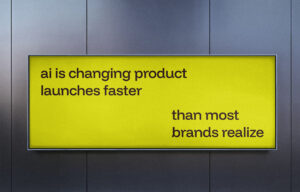
launching became continuous instead of occasional
one of the biggest changes in ai in product launch is timing.
launches used to happen once.
today they evolve continuously.
instead of:
coming soon.
launch day.
campaign ends.
brands now operate differently.
they release:
- early previews
- beta versions
- community feedback
- creator collaborations
- updates
- improvements
the launch becomes an ongoing conversation.
not a single event.
first impressions are becoming shorter
attention used to last longer.
today, people decide almost instantly whether something deserves another second.
this isn’t because attention spans disappeared.
it’s because competition exploded.
every scroll contains:
- products
- creators
- ads
- recommendations
- entertainment
your launch isn’t competing with another launch.
it’s competing with the entire internet.
this changes product launch strategy completely.
because getting attention is only the beginning.
keeping it is much harder.
ai is making originality more important
this sounds paradoxical.
if ai creates more content, shouldn’t originality become less important?
the opposite happened.
because ai made average content extremely easy to produce.
average content flooded the internet.
which means originality became more valuable.
customers notice:
- unusual thinking
- unexpected positioning
- fresh perspectives
not because they’re searching for creativity.
because they’re tired of seeing the same thing.
production became a commodity
history repeats itself.
when something becomes accessible to everyone, it stops creating competitive advantage.
printing.
photography.
video production.
website development.
all followed the same pattern.
ai is doing the same to content production.
production itself becomes infrastructure.
strategy becomes differentiation.
that’s why the future of ai launch strategy isn’t about generating more assets.
it’s about making smarter decisions.
the brands that win aren’t necessarily creating more
many businesses misunderstood ai.
they assumed success would come from publishing more.
more posts.
more ads.
more emails.
more campaigns.
but customers don’t reward volume.
they reward relevance.
publishing ten average launch assets rarely beats publishing one memorable idea.
this is becoming one of the defining characteristics of successful ai product launches.
ai exposed the difference between activity and strategy
it’s easier than ever to look busy.
feeds are full.
campaigns are everywhere.
new content appears constantly.
but activity isn’t evidence of strategy.
it’s possible to publish every day and still build nothing.
because marketing isn’t measured by output.
it’s measured by movement.
did perception change?
did positioning improve?
did people remember you?
did behavior shift?
those questions matter more than how many assets ai generated.
the new bottleneck is human
this is where the conversation changes completely.
production is no longer the hardest part.
distribution isn’t the hardest part.
tools aren’t the hardest part.
people are.
the bottleneck now is:
- strategic thinking
- positioning
- customer understanding
- creative direction
- decision-making
ai accelerates execution.
humans still determine direction.
and direction has never mattered more.
the brands that understand this won’t simply launch products faster.
they’ll launch products people actually remember.
because in the ai era, speed is available to everyone.
clarity isn’t.
and that’s where the next competitive advantage begins.
ai product marketing is becoming a speed game
the biggest misconception about ai product marketing is that it’s about automation.
it isn’t.
it’s about compression.
compression of:
- time
- production
- testing
- iteration
- learning
what once took three months can now happen in three days.
what once required five departments can now start with one strategist and a handful of ai tools.
that changes marketing more than most brands realize.
because marketing has always rewarded speed.
the difference is that speed used to belong to companies with bigger budgets.
today, speed belongs to companies with better systems.
that’s a completely different competitive landscape.
the first launch is no longer the final launch
traditional product launches treated launch day as the finish line.
everything built toward one moment.
one campaign.
one announcement.
one release.
today, launch day is simply version one.
modern brands launch, observe behavior, improve, relaunch, and optimize continuously.
every customer interaction becomes research.
every comment becomes insight.
every click becomes feedback.
this is how ai in product launch changes marketing.
instead of trying to predict the perfect campaign, brands can build one that improves every week.
testing replaced guessing
one of ai’s biggest advantages isn’t creating content.
it’s making experimentation affordable.
before ai, testing five campaign concepts meant creating five campaigns.
that required:
- designers
- copywriters
- editors
- production time
- budget
today, testing becomes significantly easier.
brands can generate multiple:
- headlines
- visuals
- landing pages
- advertisements
- product descriptions
- launch messages
before investing heavily in one direction.
the smartest product launch strategy is no longer based on confidence.
it’s based on evidence.
ai rewards curiosity more than certainty
something unexpected happens when experimentation becomes cheap.
brands stop defending ideas.
they start exploring them.
instead of asking:
“is this the right campaign?”
they ask:
“what happens if we try this?”
this mindset shift is becoming one of the biggest competitive advantages inside artificial intelligence marketing.
because certainty slows learning.
curiosity accelerates it.
the internet changed how products spread
product launches used to move through media.
today they move through people.
algorithms.
communities.
creators.
comments.
search.
recommendations.
the internet doesn’t distribute products equally.
it distributes attention.
and attention follows behavior.
not budgets.
people don’t discover products the way brands imagine
many businesses still picture customer journeys as straight lines.
someone sees an ad.
visits the website.
buys the product.
real behavior looks nothing like that.
someone might:
- notice a product on social media
- ignore it
- see it again a week later
- hear someone mention it
- search for reviews
- watch three videos
- forget about it
- receive a retargeting ad
- finally decide to buy
the purchase doesn’t happen because of one touchpoint.
it happens because dozens of small interactions build confidence over time.
this is modern product launch marketing.

launches no longer belong to brands
this sounds strange.
but it’s true.
once a product enters the internet, the conversation belongs to everyone.
customers create reviews.
creators produce opinions.
communities compare alternatives.
algorithms decide visibility.
brands control far less than they used to.
that’s why successful launches focus less on controlling the story and more on creating one worth sharing.
comments became part of the campaign
there was a time when comments were simply engagement.
today they’re part of the product experience.
people don’t just watch launch videos.
they read reactions.
they don’t only trust advertisements.
they trust discussions.
sometimes the comments influence buying decisions more than the campaign itself.
this completely changes ai product launches.
because launch assets are no longer the entire launch.
conversation is.
consumer psychology changed with the internet
technology didn’t change human psychology.
it changed the environment around it.
and environment changes behavior.
people still want:
- certainty
- belonging
- status
- convenience
- confidence
they simply pursue those things differently.
customers don’t evaluate products anymore
they evaluate signals.
signals like:
- number of reviews
- creator recommendations
- website quality
- community opinion
- shipping speed
- response time
- visual consistency
these signals reduce uncertainty.
and uncertainty is the biggest enemy of conversion.
this is one of the most important lessons in modern customer psychology.
people aren’t buying products.
they’re buying confidence.
attention became emotional
attention is no longer earned through information alone.
it’s earned through emotional relevance.
people stop scrolling because something feels:
- surprising
- relatable
- useful
- entertaining
- visually different
logic rarely stops the scroll.
emotion does.
this is why the future of ai marketing isn’t generating more information.
it’s generating stronger emotional reactions.
familiarity creates momentum
humans naturally trust familiar patterns.
that’s why repeated exposure matters.
not because repetition convinces people.
because repetition reduces uncertainty.
every encounter makes the product feel slightly safer.
slightly more normal.
slightly easier to choose.
good launches understand this.
they don’t try to convince customers once.
they build familiarity over time.
product launch strategy is becoming a living system
many companies still think a launch is a campaign.
it’s becoming something much larger.
it’s becoming a system.
a system that connects:
- positioning
- content
- creators
- community
- search
- advertising
- customer feedback
- product improvements
none of these work independently anymore.
they reinforce each other.
that’s why successful product launch strategy isn’t linear.
it’s circular.
launch.
measure.
learn.
adapt.
repeat.
consistency became more important than perfection
the internet rarely rewards perfect launches.
it rewards responsive brands.
brands that:
- improve quickly
- communicate openly
- adapt to feedback
- evolve continuously
customers no longer expect perfection.
they expect movement.
that’s one of the biggest shifts ai created.
because when iteration becomes inexpensive, standing still becomes expensive.
the future belongs to adaptive brands
the next generation of launches won’t be bigger.
they’ll be smarter.
they’ll react faster.
they’ll personalize more effectively.
they’ll learn continuously.
they’ll use ai to reduce production time while increasing strategic thinking.
because that’s the real opportunity.
ai doesn’t replace launch strategy.
it raises the standard for it.
every competitor now has access to similar tools.
what they don’t have is the same understanding of people.
and that’s still the hardest thing to replicate.
the brands that win won’t be the ones producing the most content.
they’ll be the ones that understand behavior before everyone else.
because the future of launching a new product won’t be defined by who creates faster.
it will be defined by who understands people better.
push it further
don’t ask how ai can help you launch faster.
ask how it can help you learn faster.
don’t measure how much content your team creates.
measure how quickly your launch becomes smarter.
build systems instead of campaigns.
test instead of assuming.
adapt instead of protecting the original idea.
because the future of artificial intelligence marketing isn’t about replacing marketers.
it’s about replacing slow decision-making.
production is no longer the bottleneck.
strategy is.
and in a world where everyone has access to the same technology, strategy becomes the only real competitive advantage left.
the brands that win won’t simply launch first.
they’ll understand their audience first.
and that’s a much harder advantage to copy.
push your ai credibility.
push your ai positioning.